Self-development and goal-setting
Niyo Program Details
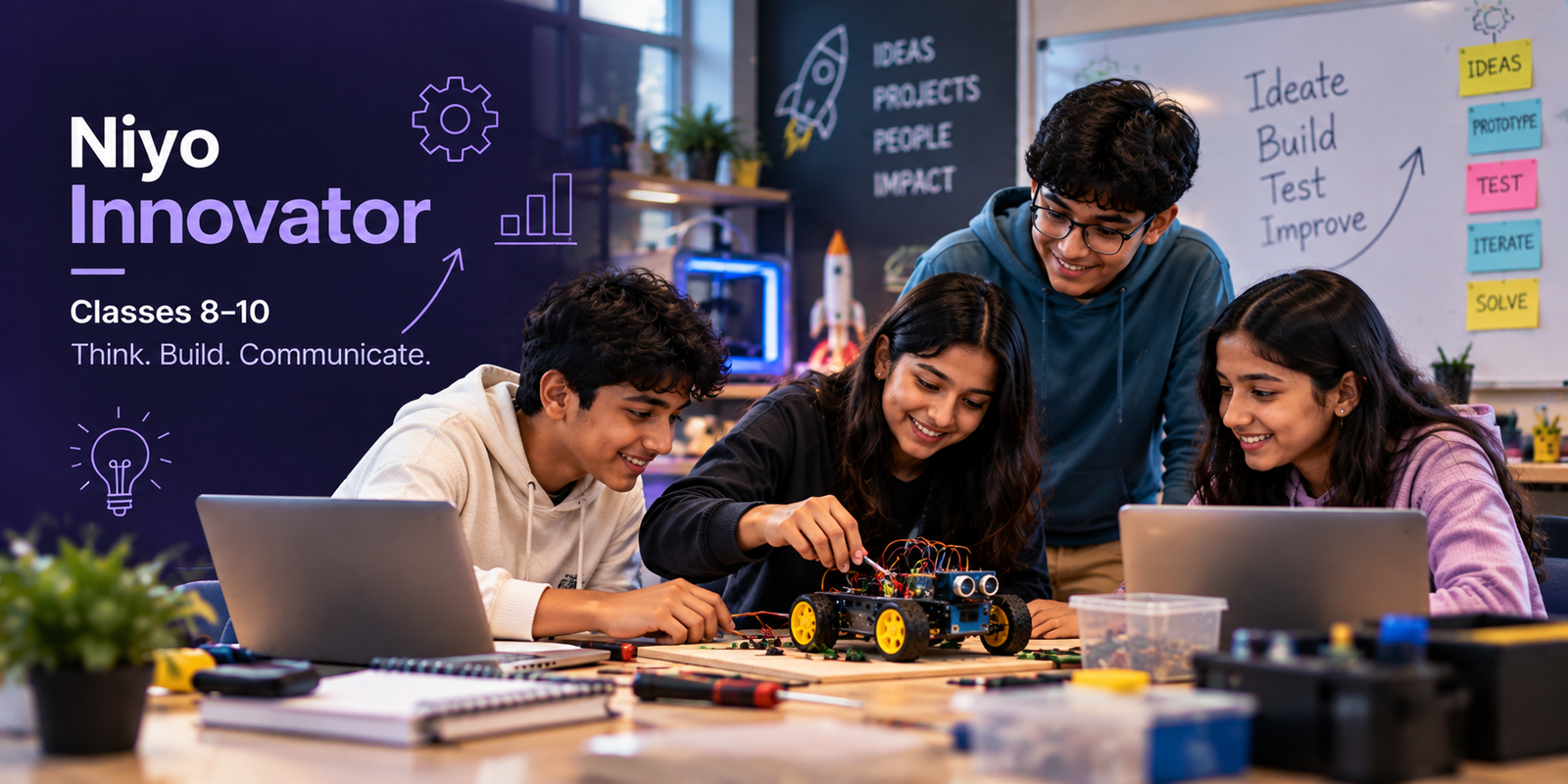
Niyo Innovator
Niyo Innovator
From learner to capable, articulate innovator.
Think better. Speak better. Build better.
Parent Promise
From learner to capable, articulate innovator.
A 12-week confidence, communication and future-readiness program that develops independent thinking, public speaking, digital intelligence, leadership and execution — followed by a 12-week Innovator Project and the opportunity to qualify for the Niyo Innovator Expo.
About the Program
Niyo Innovator is the middle stage of the Niyo journey. Students move beyond discovery and begin taking greater ownership: forming opinions, speaking publicly, thinking critically, leading teams and building ideas that can be tested with real evidence.
The transformation
Students progress from having ideas to being able to explain, build, test and defend those ideas with evidence.
Confidence and initiative
Structured communication
Public speaking and storytelling
Critical reasoning
Responsible AI and digital intelligence
Real-world independence
Teamwork and leadership
Creative and innovative thinking
Building, testing and defending an idea with evidence
Why Niyo Innovator
Learning that becomes visible capability.
The program is structured around progressive missions, real evidence of growth and age-appropriate application — not disconnected workshops.
Confidence becomes capability
Students move from basic confidence to initiative, structured communication and public speaking.
Independent thinking
They learn to question assumptions, consider evidence, recognise bias and form reasoned conclusions.
Digital intelligence
AI, hallucinations, algorithms, deepfakes, privacy, verification and ethical use become practical learning areas.
Leadership in practice
Students lead small activities, delegate, handle disagreement, receive feedback and reflect on leadership.
Build and test
Ideas are taken through prototyping, experimentation, user feedback, evidence and iteration.
Evidence over polish
Students learn that a strong project is supported by research, testing and improvement — not simply presentation quality.
Learn
Weeks 1–12
Recorded class + progressive weekly mission.
Apply
Weeks 13–24
Research, create, build, test and improve.
Submit
End of Week 24
Portfolio + project + reflection + presentation.
Select
Post Submission
Rubric-based review and finalist selection.
Showcase
Niyo Expo
Selected students present to judges and audience.
Weeks 1–12
A progressive learning journey — week by week.
Every week introduces new learning and ends with a practical mission. Each mission creates evidence for the student’s Niyo Portfolio and prepares them for what comes next.
Week
1
Self-awareness
Know Yourself
Strengths, identity, habits, values, interests and personal growth goals.
Weekly Mission: Create a Personal Growth Dashboard showing today, areas to improve and three six-month goals.
Week
2
Confidence
Confidence Is a Skill
Fear of judgement, comparison, body language, preparation, mistakes and initiative.
Weekly Mission: Complete a seven-day Confidence Challenge with one small action each day.
Week
3
Communication
Communication That Works
Clarity, tone, listening and the Point → Reason → Example → Conclusion framework.
Weekly Mission: Record a two-minute opinion video using the communication framework.
Week
4
Public speaking
Own the Stage
Hooks, eye contact, gestures, voice variation, pauses, nervousness and recovery.
Weekly Mission: Deliver and record a three-minute speech to a real audience.
Week
5
Storytelling
Storytelling & Influence
Story, analogy, examples, emotion and memorable communication.
Weekly Mission: Rework the previous speech into a story-driven version and record it again.
Week
6
Critical thinking
Think Before You Agree
Assumptions, evidence, bias, misinformation, multiple perspectives and basic cause/effect reasoning.
Weekly Mission: Prepare Argument For + Argument Against + Evidence-Based Conclusion on one claim.
Week
7
Digital intelligence
AI, Internet & Digital Intelligence
Prompting, hallucinations, deepfakes, algorithms, privacy, digital reputation, verification and ethical use.
Weekly Mission: Create an AI Reliability Report with useful output, doubtful output, verified information and the student’s own conclusion.
Week
8
Independence
Real-World Skills
Professional messages, email, scheduling, deadlines, planning, information organisation and asking good questions.
Weekly Mission: Complete one Real-World Challenge such as planning an activity, interview or coordinated task.
Week
9
Leadership
Teamwork & Leadership
Initiative, delegation, accountability, conflict, feedback and recognising strengths in others.
Weekly Mission: Lead a mini team activity with two to four people and submit a Leadership Reflection.
Week
10
Innovation
Creative & Innovative Thinking
Observation, constraints, combining ideas, alternatives and meaningful opportunities.
Weekly Mission: Choose a topic, problem or opportunity connected to personal interests and generate multiple approaches.
Week
11
Execution
Build & Test
Prototype, experiment, research, feedback, failure, testing and iteration.
Weekly Mission: Build Version 1 and test it with people, data or experiments as appropriate.
Week
12
Presentation
Present Your Thinking
Context, discovery, idea, evidence, creation, learning and next steps.
Weekly Mission: Submit the Niyo Innovator Project Blueprint and a three-to-five-minute presentation.
Weeks 13–24 •
Innovator Project
Investigate. Design. Build. Test. Demonstrate.
After the learning phase, students spend twelve weeks applying what they learned through a structured project journey with checkpoints, feedback and evidence.
Investigate
Define the topic or challenge, collect evidence, research existing approaches and establish what success means.
Checkpoint
Research + project objective
Design
Generate alternatives, choose an approach and create a detailed project plan.
Checkpoint
Solution / project blueprint
Build
Create a serious first version: model, experiment, digital product, research study, campaign, system or creative solution.
Checkpoint
Version 1
Test & Improve
Test with real users, data or experiments, document feedback and build a stronger version.
Checkpoint
Testing evidence + Version 2
Demonstrate
Organise evidence, reflect on learning, create the final report and prepare the presentation.
Checkpoint
Final submission
Science & Discovery
Experiments, scientific investigations, health, physics, biology, chemistry and space.
Technology & AI
Apps, AI concepts, coding, robotics, automation and digital tools.
Environment & Sustainability
Water, waste, energy, biodiversity, climate and sustainable living.
Design & Engineering
Products, devices, accessibility, structures and everyday engineering.
Society & Human Behaviour
Education, safety, habits, communication, wellbeing and communities.
Creative Innovation
Media, visual communication, storytelling, architecture, design and interactive experiences.
The Innovator stage is designed around evidence and iteration. Students are encouraged to test assumptions, learn from failure and strengthen their work instead of treating the first version as the final answer.
Submission & Evaluation
Evidence of growth, not another marks race.
Students are evaluated through their work, evidence, improvement, reflection and ability to communicate what they learned.
Final submission
- ✓ Innovator Portfolio
- ✓ Problem or topic research and evidence
- ✓ Project blueprint
- ✓ Version 1 and testing record
- ✓ Final version or result
- ✓ Reflection on failure, feedback and improvement
- ✓ Three-to-five-minute presentation video
Evaluation framework
Understanding & research
20%
Creativity & originality
20%
Quality of execution
20%
Testing & evidence
15%
Improvement & learning
10%
Potential impact / relevance
10%
Communication
5%
Scholarship note:
Scholarships and awards are competitive and are not
guaranteed to every participant. Eligibility, judging,
award amounts and timelines should be published for
each cohort or Expo.
The Destination
NIYO INNOVATOR EXPO — Ideas That Can Change Tomorrow
Outstanding projects can be selected for the relevant Niyo Expo, where students explain their work, answer questions and showcase what they have built or discovered.
Suggested Presentation Format
3–5 minute presentation + evidence/demo + judges’ Q&A
Recognition categories
Innovator of the Year
Best Scientific / Research Project
Best Technology / Design Project
Best Sustainability / Social Project
Most Original Idea
Best Research & Evidence
Best Communication
Niyo Innovator
Talk to Niyo
Ready to prepare for what comes beyond exams?
Speak with the Niyo team to understand the program, upcoming cohorts, eligibility and how the six-month journey works.